Simulate Lyotropic Liquid Crystal Membranes
Background
Lyotropic liquid crystals (LLC) are amphiphilic molecules that can self-assemble into nanostructured phases dependent on the amount of water present in solution. LLC monomers with crosslinkable functional groups can be polymerized in order to create stable and mechanically robust films that can be used as separations membranes.
We are interested in studying the inverted hexagonal (HII) and bicontinuous cubic phases (QI) formed by LLC monomers. The hydrophilic pores of cross-linked nanostructured LLC membranes are uniform in size and contain interacting functional groups which makes them ideal for selective separations.
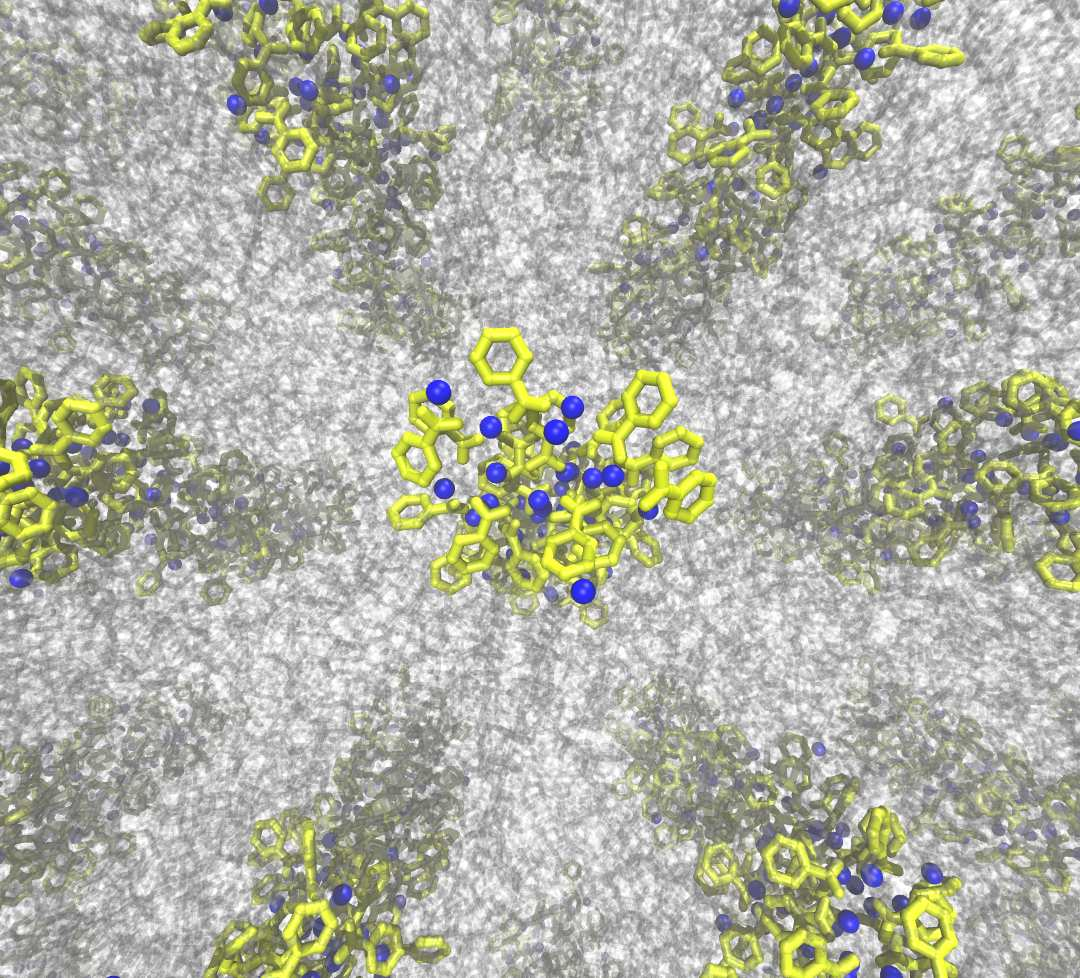
The HII phase geometry (top left image) consists of hexagonally packed and uniform-sized pores. In the presence of water, LLC monomers spontaneously self-assemble into hexagonal mesophases that are isotropically oriented with respect to each other. In this state, transport is inherently slow. A fully aligned HII phase membrane with continuous through-pores represents the ideal geometry for high throughput separations. Aligning the hexagonal mesophases on a large scale is not trivial. Successful efforts have been made on a small scale (see [1] and [2]), however more work needs to be done to make this a viable membrane. Nevertheless, the primary focus of our simulations to date has been with the HII phase because its geometry is simple to model.
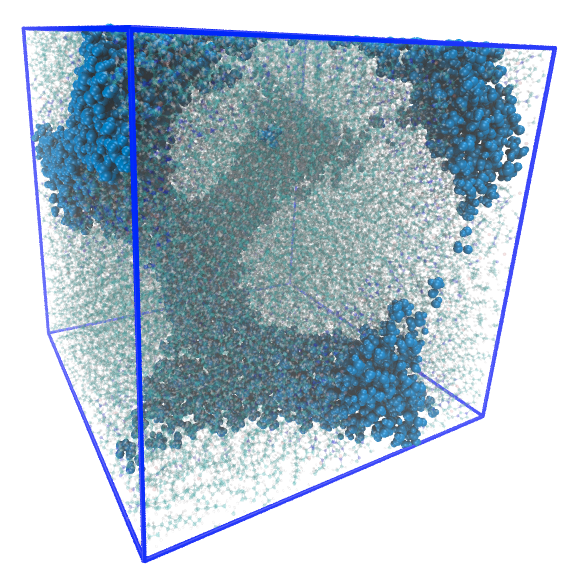
The QI phase (top right image) consists of a tortuous network of 3D interconnected pores. This geometry does not require alignment and therefore has been studied as a separations membrane far more than the HII phase. The high selectivity of these membranes has been studied and applied to complex waste streams such as hydraulic fracturing flowback water [3] [4] [5]. To date, we have learned to build atomstic unit cells for these systems and we plan to carry out the same analyses applied to the HII system but adapted to the more complex QI geometry.
Effective use of this repository
The tools in this repository are intended for studying structure and transport within HII or QI phase membranes formed by liquid crystal monomers.
Most of the tools are built using python and are tested to work with output files generated by molecular simulations run with GROMACS. See our full list of Software Requirements.
The process of screening an LLC system composed of a given monomer can summarized in three stages:
- Parameterization: In most cases, you will need to build and parameterize monomers before building a full membrane. Instructions and scripts to do this are given in the Preparation of Monomers and Solutes section.
- System Construction and Simulation: Next, you will need to build a unit cell and create input files for GROMACS simulations. See our System Setup section for instructions.
- Analysis: Once your simulations are run, you can conduct Post-Simulation Trajectory Analysis.
For convenience, most scripts wrap around a class and can stand alone. Using the argparse module, one can pass arguments that give instructions on how to apply the underlying class where all of the real calculations occur.
Note that modules in LLC_Membranes.llclib (see Useful Functions) are an exception and cannot stand alone. Each module contains a set of functions that are frequently used in other modules. Any function or class that is used more than once should be in an appropriate llclib module.
A directory tree would go well here to make importing more intuitive
Publications
Coscia, Benjamin J., Joseph Yelk, Matthew A. Glaser, Douglas L. Gin, Xunda Feng, and Michael R. Shirts. “Understanding the Nanoscale Structure of Inverted Hexagonal Phase Lyotropic Liquid Crystal Polymer Membranes.” The Journal of Physical Chemistry B 123, no. 1 (January 10, 2019): 289–309. https://doi.org/10.1021/acs.jpcb.8b09944.
Coscia, Benjamin J., and Michael R. Shirts. “Chemically Selective Transport in a Cross-Linked HII Phase Lyotropic Liquid Crystal Membrane.” The Journal of Physical Chemistry B, June 27, 2019. https://doi.org/10.1021/acs.jpcb.9b04472.
Indices and tables
References
| [1] | Feng, Xunda, Marissa E. Tousley, Matthew G. Cowan, Brian R. Wiesenauer, Siamak Nejati, Youngwoo Choo, Richard D. Noble, Menachem Elimelech, Douglas L. Gin, and Chinedum O. Osuji. “Scalable Fabrication of Polymer Membranes with Vertically Aligned 1 Nm Pores by Magnetic Field Directed Self-Assembly.” ACS Nano 8, no. 12 (December 23, 2014): 11977–86. https://doi.org/10.1021/nn505037b. |
| [2] | Feng, Xunda, Siamak Nejati, Matthew G. Cowan, Marissa E. Tousley, Brian R. Wiesenauer, Richard D. Noble, Menachem Elimelech, Douglas L. Gin, and Chinedum O. Osuji. “Thin Polymer Films with Continuous Vertically Aligned 1 Nm Pores Fabricated by Soft Confinement.” ACS Nano 10, no. 1 (January 26, 2016): 150–58. https://doi.org/10.1021/acsnano.5b06130. |
| [3] | Hatakeyama, Evan S., Christopher J. Gabriel, Brian R. Wiesenauer, Jenny L. Lohr, Meijuan Zhou, Richard D. Noble, and Douglas L. Gin. “Water Filtration Performance of a Lyotropic Liquid Crystal Polymer Membrane with Uniform, Sub-1-Nm Pores.” Journal of Membrane Science 366, no. 1–2 (2011): 62–72. https://doi.org/10.1016/j.memsci.2010.09.028. |
| [4] | Hatakeyama, Evan S., Brian R. Wiesenauer, Christopher J. Gabriel, Richard D. Noble, and Douglas L. Gin. “Nanoporous, Bicontinuous Cubic Lyotropic Liquid Crystal Networks via Polymerizable Gemini Ammonium Surfactants.” Chemistry of Materials 22, no. 16 (August 24, 2010): 4525–27. https://doi.org/10.1021/cm1013027. |
| [5] | Dischinger, Sarah M., James Rosenblum, Richard D. Noble, Douglas L. Gin, and Karl G. Linden. “Application of a Lyotropic Liquid Crystal Nanofiltration Membrane for Hydraulic Fracturing Flowback Water: Selectivity and Implications for Treatment.” Journal of Membrane Science 543, no. Supplement C (December 1, 2017): 319–27. https://doi.org/10.1016/j.memsci.2017.08.028. |